Blatrixo Machine
Why is dust management critical in blasting operations? Because every blast can turn a visible cloud into an invisible exposure problem. Abrasive particles, coating debris, and material from the work surface may enter the air around operators and nearby crews. Some dust may contain respirable crystalline silica or other hazardous substances, depending on the materials involved. The risk is not always obvious. A worker can leave a booth with dust on their sleeves and still have faced the greater hazard in the air they breathed.
Dr. John Howard, an occupational-health physician and former director of the U.S. National Institute for Occupational Safety and Health, has helped bring workplace exposure prevention into public focus. A practical principle consistent with that work is: “Control dust at its source, before it reaches a worker’s breathing zone.” This is a paraphrase, not a verbatim quotation. In blasting, that principle can mean containing the work area, using effective extraction or suitable wet methods, and checking that controls perform as intended. Respiratory protection may also be needed, selected and managed by qualified professionals. Details matter: a poorly positioned extraction hood can leave a worker standing in the plume. Dust on the floor is easy to notice; fine airborne particles are not. And even a well-designed system can fail when maintenance slips. That is worth admitting. Strong dust management protects workers, improves visibility, and supports consistent work, but no single control makes exposure disappear. Reliable practice depends on observing the process, measuring where appropriate, and correcting weaknesses before they become routine.
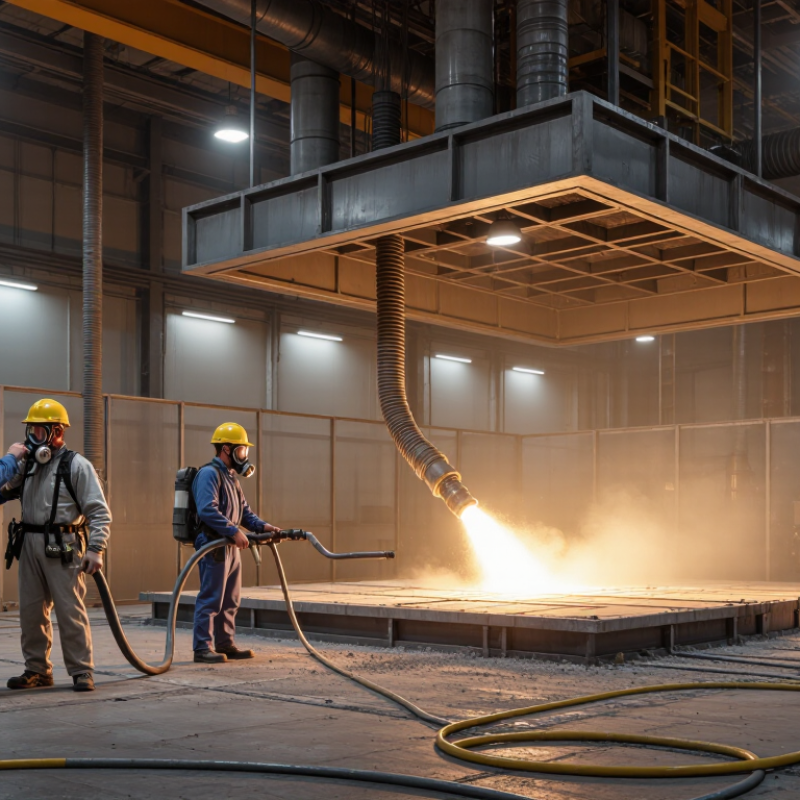
Dust generation during blasting begins at the point of impact. Abrasive particles strike coatings and substrates, breaking both into airborne fragments. The plume may contain spent media, paint or rust particles, and fine material from the surface itself. NIOSH’s 2002 guidance on abrasive blasting identifies respirable dust, including crystalline silica from certain materials, as a key exposure concern. The mix changes with the abrasive, coating, substrate, and blasting conditions. A steel surface with old paint does not produce the same dust as concrete.
The finest particles are often the hardest to notice. They can remain suspended after the visible cloud has thinned, settling on nearby ledges or drifting beyond the work area.
OSHA’s 2016 respirable crystalline silica rule sets an eight-hour permissible exposure limit of 50 micrograms per cubic meter, with an action level of 25 micrograms. These figures make clear that small concentrations matter.
A clean-looking bay can still be a poor indicator of exposure; visibility is not a measurement. In practice, operators should assess the material being blasted and use exposure monitoring where appropriate. Dust behavior is variable, and that uncertainty is easy to underestimate.
Blasting dust is more than a visibility problem. Its composition depends on the surface, coating, and abrasive being removed. Fine particles can travel beyond the immediate work area and remain airborne after blasting stops. Some may contain respirable crystalline silica, metals, or residues from old coatings. Workers can inhale particles they cannot see.
Exposure may irritate the eyes, skin, and airways, causing coughing or shortness of breath. Repeated exposure to certain dusts can contribute to serious, lasting lung disease. Symptoms are not a reliable warning; a worker may feel fine while breathing hazardous particles. That is easy to underestimate. A dusty collar or grit on a nearby ledge can signal that controls need attention, but appearance alone cannot measure exposure.
Effective protection starts with identifying the materials involved and assessing airborne dust. Enclosures and local exhaust ventilation can capture particles near their source. Avoid dry sweeping or blowing settled dust with compressed air, since both can put it back into the air. Select respiratory protection based on the hazard assessment, and ensure it fits and is used correctly. Check controls during work, not only before the shift. A quiet fan or clear view does not prove the air is safe.
During abrasive blasting, spent media and removed coatings can suspend fine particles in the work area. A visible haze may hide surface defects, edges, or nearby workers. Visibility drops fast. When operators cannot see the surface clearly, they may miss uneven coverage or continue blasting one spot too long. That can leave a rough finish or damage the substrate.
Dust also settles on hoses, controls, filters, and moving parts. Fine particles can clog filters or contribute to wear when they enter equipment. Regular checks help: inspect filter condition, clean dust from sensitive areas, and keep extraction systems working as intended. Small details matter. A blocked intake may not look serious at first, but airflow can weaken before anyone notices.
Work quality depends on more than the blasting technique. Dust left on a surface can interfere with coating adhesion or make inspection less reliable. Use suitable dust collection and ventilation, and check the surface under clear lighting before the next step. Even a well-planned setup can miss a corner or capture dust unevenly. Adjusting the extraction position and checking conditions during the job are practical habits, not guarantees.
| Operational Area | How Dust Affects the Operation | What to Monitor | Practical Dust-Control Measures |
|---|---|---|---|
| Visibility and operator awareness | Airborne dust can obscure the work surface, nearby workers, and hazards. Poor visibility makes it harder to maintain consistent nozzle distance and coverage. | Visibility within the enclosure, dust escaping from the work area, and whether operators can clearly inspect the surface. | Use suitable enclosure ventilation and dust collection; keep access points sealed where practicable; stop and correct visible dust leakage. |
| Worker exposure and health | Blasting can generate respirable particles. Depending on the abrasive and coating being removed, dust may contain hazardous substances, including respirable crystalline silica or metals. | Abrasive and coating composition, task-specific exposure, and the effectiveness of engineering controls and respiratory protection. | Identify dust hazards before work, use effective engineering controls, and apply the required exposure assessment and respiratory-protection program. In the United States, OSHA’s silica standard sets a permissible exposure limit of 50 µg/m³ as an 8-hour time-weighted average and an action level of 25 µg/m³. |
| Blasting equipment | Dust and abrasive debris can accumulate in equipment and surrounding components, contribute to wear or blockage, and increase cleaning and maintenance needs. | Collector airflow and filter condition, hose and nozzle condition, separator performance, and signs of dust buildup or leakage. | Inspect and maintain dust collectors and blast equipment; replace or clean filters according to the manufacturer’s instructions; remove settled dust using methods that limit re-suspension. |
| Surface preparation quality | Residual dust or abrasive on a prepared surface can interfere with coating application and may contribute to coating defects or poor adhesion. | Surface cleanliness, visible residual dust, and any specified surface-dust assessment or acceptance criteria. | Remove dust after blasting using an approved cleaning method, inspect the surface before coating, and follow the project specification for cleanliness and dust testing. |
| Productivity and rework | Dust-related visibility problems, equipment cleaning, and surface re-cleaning can interrupt work and add time before inspection or coating. | Downtime, repeat cleaning, inspection findings, and coating-preparation rework. | Plan dust collection and cleanup as part of the work sequence; verify controls before blasting; document inspections and address recurring dust sources. |
Note: Dust composition and exposure risk depend on the abrasive, substrate, and material being removed. Apply the applicable regulations, safety data, and project requirements.
Dust control works best where particles become airborne: at the blast stream, the work surface, and abrasive transfer points. A properly positioned extraction hood can capture the plume before it spreads across the enclosure. Keep it close. Keep it clear of the operator’s movement path. Inspect duct connections and filters for leaks or heavy loading. Weak airflow can make a system look active while dust escapes around the work.
Where the process allows it, wet blasting or a controlled water mist can reduce airborne fines at impact. Moisture is not a universal fix: it may affect the substrate, abrasive, visibility, or cleanup. Test it on a representative area first. For dry blasting, enclosed cabinets or blast rooms should use effective local exhaust and suitable negative pressure. Monitor airflow during operation, not just at startup. Dust collection equipment must match the material and expected loading.
Control dust before it settles. Transfer abrasive gently, use covered containers, and clean floors with an industrial vacuum suited to fine dust. Avoid dry sweeping or blowing deposits into the air. It is tempting to treat a visible cloud as the only warning; that is a poor measure. Fine particles can remain suspended after the room looks clear, so routine checks and suitable respiratory protection still matter.
OSHA exposure benchmarks for respirable crystalline silica
OSHA’s action level is 25 µg/m³ and its permissible exposure limit (PEL) is 50 µg/m³, each measured as an 8-hour time-weighted average. These limits apply to respirable crystalline silica, not total dust. Reduce dust at its source with suitable wet methods, enclosed blasting systems, and local exhaust ventilation.
Source: OSHA, 29 CFR 1910.1053.
Dust monitoring makes control measurable. In abrasive blasting, a clear view does not prove clean air; fine particles can remain suspended after the visible cloud settles. When crystalline silica is present in the abrasive or surface, OSHA’s respirable silica standard sets an action level of 25 micrograms per cubic meter and a permissible exposure limit of 50 micrograms per cubic meter, averaged over eight hours. These figures apply to respirable crystalline silica, not every type of dust. Personal breathing-zone samples can show what operators actually inhale, while area monitors help identify leaks near enclosures and exhaust points. One sample is not enough. Wind, nozzle position, and changing media can shift readings during a shift.
Pair sampling with regular checks of the controls. Inspect enclosure seals, confirm exhaust airflow, and track dust-collector pressure readings against the equipment’s operating range. A sudden change deserves investigation. Repeat measurements after repairs or process changes, and keep results with dates, task details, and control settings. NIOSH’s 2016 Current Intelligence Bulletin 68 also discusses respirable silica exposure limits and health risks, supporting a cautious approach to sampling and exposure reduction. A weak point in many plans is relying on visible dust alone. It is easy to miss what cannot be seen.
Fine particles may stay airborne after the visible cloud settles. Some are too small to see.
Dust may irritate the eyes, skin, and airways. Repeated exposure to certain particles can contribute to lasting lung disease.
No. A worker may feel fine while breathing hazardous particles. That is easy to underestimate.
Identify the surface, old coatings, and abrasive. These materials may contain silica, metals, or other residues.
For respirable crystalline silica, an action level is 25 micrograms per cubic meter. The eight-hour exposure limit is 50 micrograms per cubic meter. These figures do not apply to every kind of dust.
Personal breathing-zone samples measure exposure near an operator. Area monitors can help locate leaks around enclosures or exhaust points.
Not always. Wind, nozzle position, and abrasive changes can shift readings. One sample can leave gaps.
Inspect enclosure seals, exhaust airflow, and dust-collector pressure. Repeat measurements after repairs or process changes. A clear view is not proof.
Blasting can release fine particles from abrasive materials, coatings, and surface debris, making dust control an essential part of safe and effective work. Understanding why is dust management critical in blasting operations begins with the health risks: airborne dust may irritate the eyes and respiratory system, and repeated exposure can cause more serious harm. Dust also reduces visibility, making it harder for workers to inspect surfaces and coordinate tasks. It can settle on equipment, contribute to wear or malfunctions, and interfere with the quality and consistency of the finished surface.
Effective control starts at the source. Practical measures include using suitable dust-collection systems, enclosing work areas where appropriate, and selecting methods that limit dust release. Workers should also use appropriate protective equipment and follow safe work procedures. Regularly monitoring airborne dust levels helps identify problems early, while routine inspection and maintenance keep control measures working as intended. Together, these steps support healthier work conditions, clearer visibility, reliable equipment, and better blasting results.
